
Massive 2025 WASSCE failure signals deep secondary education crisis – CEPM
The Center for Education Policy and Management (CEPM), a think tank under The Orpington Group, has raised alarm over what it describes as a major collapse in the management of secondary education, following a drastic decline in Ghana’s 2025 WASSCE results.
A comparative analysis of the 2024 and 2025 outcomes shows that nearly 250,000 fewer students secured A1–C6 passes in the four core subjects required for entry into tertiary institutions.
CEPM said the figures signal an unprecedented national education emergency.
According to the think tank, Core Mathematics suffered the most severe decline, with A1–C6 passes dropping from 305,132 in 2024 to 209,068 in 2025—a staggering fall of more than 96,000 passes. The current pass rate of 48.73%, it is noted, means more than half of candidates failed to obtain the grades needed for university admission.
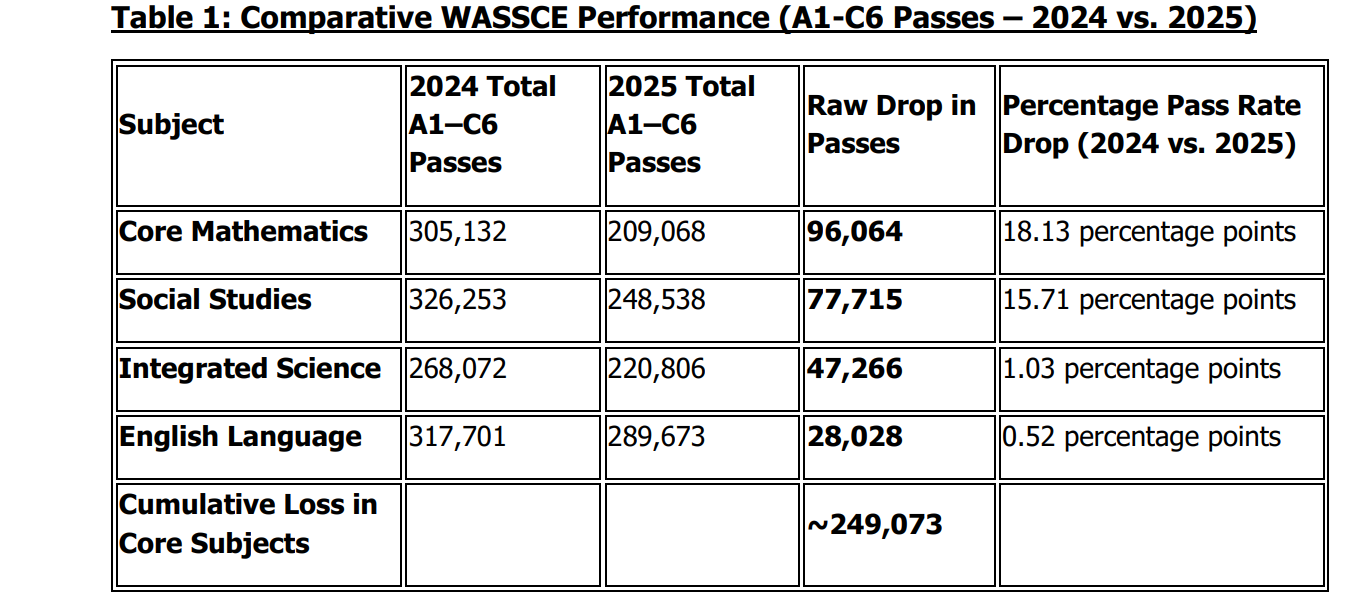
Social Studies also recorded a drop of more than 77,000 passes, while Integrated Science and English Language saw declines of 47,266 and 28,028 passes, respectively. CEPM argues that the combined loss across the four core subjects represents “a quarter of a million futures restricted,” warning that the implications for Ghana’s human capital pipeline are grave.
“This crisis is not a failure of access but a fundamental failure of execution and management,” CEPM stated. “The data confirms that systemic administrative lapses over the past year have severely undermined the quality of teaching and learning under the Free SHS framework.”
The think tank attributed the decline to what it called chronic mismanagement, pointing to the withdrawal of Academic Intervention Grants, the absence of specialised continuous professional development for teachers, and delays in funding that disrupted feeding, logistics, and the provision of essential teaching and learning materials.
CEPM also highlighted rising examination malpractice as further evidence of a system under strain, with thousands of subject results cancelled and dozens of individuals facing prosecution for compromising exam integrity.
Calling for urgent corrective action, the organisation urged the Ministry of Education to ring-fence a dedicated quality enhancement fund, ensure timely and predictable release of funds to schools, and fast-track completion of outstanding educational infrastructure to reduce overcrowding.
CEPM warned that Ghana risks undoing years of progress in expanding access and improving outcomes at the secondary level if immediate steps are not taken to stabilise the system.
“Ghana cannot celebrate years of gains only to mourn mass academic failure this year,” the think tank said. “The government must shift from political promotion to professional management to safeguard the future of the children who depend on this vital policy.”